






The Physics of Addiction: How "Match Factory!" Revolutionized the Puzzle Genre Through Tactile Chaos
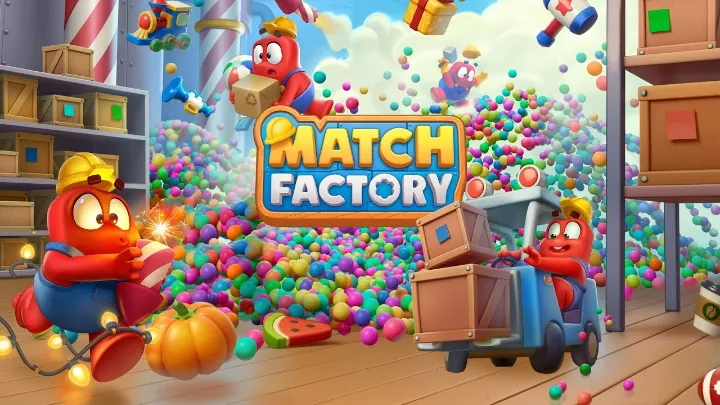
In the brutally saturated landscape of mobile gaming, few genres are as fiercely competitive as the puzzle category. For over a decade, the "Match-3" formula, popularized by titans like Candy Crush Saga and later refined by Royal Match, has dominated the charts with a simple, unyielding premise: the grid. The logic was always X and Y. Swap adjacent items, clear lines, repeat. However, a new challenger has emerged from the studios of Peak Games, the developers behind Toon Blast. That challenger is Match Factory!. While it may masquerade as just another casual time-killer, Match Factory! represents a seismic paradigm shift in mobile game design. It abandons the safety of the strategic grid for a chaotic, physics-based 3D environment.
This analysis will not serve as a review of game mechanics or a guide for beginners. Instead, we will conduct a forensic deep-dive into the specific psychological and technical engineering behind Match Factory!. We will explore how the game leverages "tactile satisfaction" and the "clutter effect" to induce a unique flow state, and how it weaponizes this state to create one of the most aggressive, yet invisible, monetization loops in the modern mobile market. By understanding the friction between the user’s primal desire for order and the game’s chaotic physics engine, we can uncover the secret sauce that keeps millions of players glued to their screens, frantically digging through digital piles of rubber ducks and shiny buttons.
1. The Stagnation of the Grid: Why the Market Demanded a Third Dimension
For nearly fifteen years, the puzzle genre was defined by static coordinates. Games like Bejeweled and Candy Crush operated on a strict grid system where the difficulty was derived from limited moves and board layout configuration. While this formula is timeless, it suffers from an inherent "strategic ceiling." Once a player understands the algorithm—how candies fall, how blockers work—the game becomes a matter of calculation rather than reaction. The visual feedback loop is static; a candy sits in row 3, column 4, and stays there until moved. This lack of dynamism eventually leads to what industry experts call "grid fatigue," where the dopamine hit from clearing a level diminishes because the visual experience is indistinguishable from level 1 to level 1000.
The market was ripe for disruption, but the transition to 3D matching had historically been clumsy. Early 3D matching games suffered from camera issues, poor optimization, or confusing perspectives that alienated casual players who preferred the clarity of 2D. The challenge was to maintain the simplicity of "matching three things" while introducing the complexity of a 3D space. Peak Games identified that the missing link wasn't just 3D graphics, but 3D physics. The items needed to feel like they had mass, friction, and presence. This shift from a strategic grid to a physical pile fundamentally changed the player's relationship with the game screen, moving from a "commander" overlooking a battlefield to a "worker" digging through a mess.
2. The "Clutter Effect": The Psychology of Cleaning Up
At its core, Match Factory! taps into a primal psychological drive: the compulsion to organize chaos. Unlike grid games where the board is orderly, a level in Match Factory! begins with a heap of junk. It triggers a mild form of psychological anxiety known as the "Clutter Effect." Studies in environmental psychology suggest that humans are wired to find clutter stressful; it represents unfinished business and cognitive overload. When the game presents a messy pile of overlapping items, the player's brain immediately signals a need to resolve this disorder. This is the hook. It is not just about scoring points; it is about cleaning up.
This mechanic creates a satisfaction loop similar to the "Marie Kondo" method of decluttering. Every triple match removes items from the screen, literally creating empty space and reducing visual noise. This process of subtraction is far more visceral than the substitution mechanic of traditional match-3 games. In Candy Crush, when you match candies, new ones fall in to replace them; the board is always full. In Match Factory!, you are emptying the board. This creates a tangible sense of progress that is deeply soothing to the human brain, turning a digital game into a virtual cleaning simulator that relieves anxiety while simultaneously creating it through the timer.
The Role of Object Permanence
Another psychological layer is object permanence. In 2D games, items are abstract symbols. In Match Factory!, the items are distinct, familiar objects: a red car, a green dinosaur, a glazed donut. Because they tumble, rotate, and collide, the brain perceives them as "real" objects occupying digital space. This increases the sense of ownership and the compulsion to sort them, strengthening the engagement loop beyond simple pattern recognition.
3. The Physics Engine: Creating Tactile Immersion
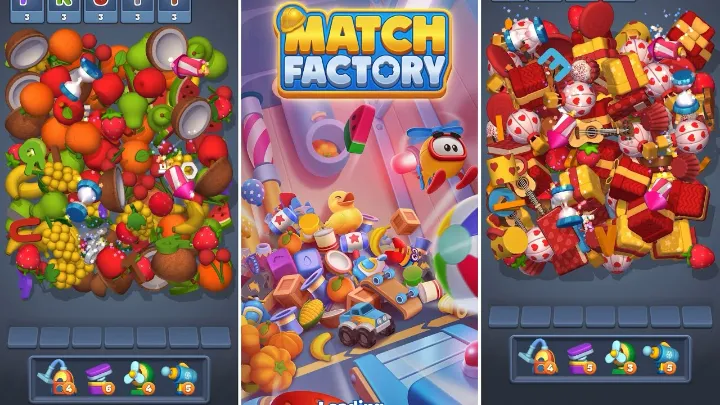
The "secret sauce" of Match Factory! is its proprietary physics engine. This is the specific technical achievement that elevates it above the sea of clones. The items in the pile do not merely exist; they interact. If you pull a wrench from the bottom of the pile, the items on top shift, slide, and tumble down realistically. This creates a "Dynamic Difficulty." A target item might be visible one second, but a shift in the pile caused by your previous move might bury it under a large teddy bear. This unpredictability prevents the player from planning too far ahead, forcing them into a reactive, instinctual state.
The physics engine also contributes to the critical element of "Game Feel." The developers have tuned the collision detection and gravity to feel "juicy." Items have a satisfying weight when they are tossed into the collection bar below. They don't just teleport; they travel. This travel time adds tension. Furthermore, the collision physics allow for emergent gameplay moments, such as using a large object to sweep smaller objects aside to reveal hidden layers. This interactivity makes the screen feel like a toy box rather than a spreadsheet, increasing the tactile immersion that keeps players touching the screen even when they aren't making matches.
4. Visual Obfuscation: The Art of Hiding in Plain Sight
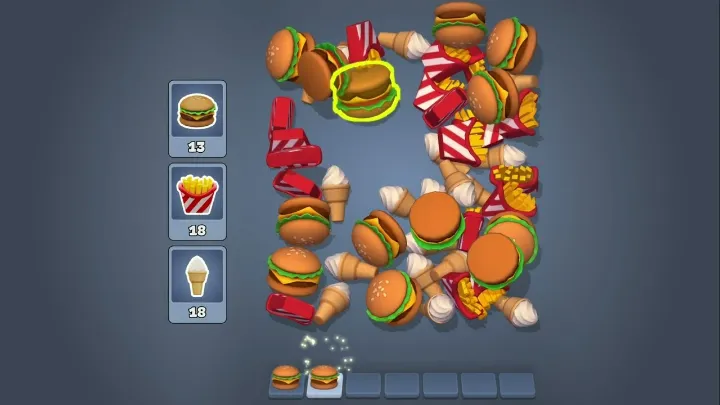
While the game presents itself as a test of speed, it is arguably a test of visual processing. The specific design challenge here is "Visual Obfuscation." The game designers deliberately choose color palettes and object shapes that blend together when piled up to create cognitive friction. For example, a level might demand you find red strawberries, but the pile is also populated with red fire trucks, red balls, and red lipsticks. This forces the player to distinguish objects based on silhouette rather than color, significantly increasing the cognitive load.
This design choice creates a difficulty curve that is not based on logic, but on perception. As levels progress, the objects become more visually similar or smaller in size relative to the screen. The game also utilizes "blocker" items—large, non-target objects that serve no purpose other than to physically obscure the view. The player must physically move these blockers aside (interact with the physics) to see the targets. This requirement to manually manipulate the environment to gain information is a massive departure from traditional puzzle games where all information is available at a glance.
Types of Visual Blockers
- The Large Inert Object: Big teddy bears or steering wheels that cover 20% of the screen but cannot be matched.
- The Color Camouflage: Items that share the exact hex code of the background or target items to fool peripheral vision.
- The Geometry Trap: Thin items like pencils or rulers that slide between larger items, becoming almost invisible to the naked eye.
5. The Timer: Shifting from Strategy to Adrenaline
Traditional match-3 games usually limit the number of moves a player can make. Match Factory! limits the time. This is a critical distinction that changes the genre from "Strategy" to "Action." A move limit allows the player to put the phone down, think, and calculate the optimal path. A time limit demands constant, unbroken attention. There is no pause for thought. This induces a state of high-adrenaline flow. The player enters a "twitch" state where they are matching faster than they are consciously thinking, relying on muscle memory and pattern recognition.
This time pressure is the primary driver of monetization. When a player runs out of moves in a grid game, they can look at the board and realize they are doomed five moves in advance. When a player runs out of time in Match Factory!, it often happens while they are in a frantic rhythm, perhaps only one match away from victory. The "Near Miss" psychology is far more potent with a timer. The sudden stop of the game when the clock hits zero creates a jarring interruption to the flow state, making the impulse to spend currency to buy "Extra Time" incredibly difficult to resist.
6. The Monetization of "Flow": The Cost of Continuation
The monetization strategy of Match Factory! is aggressive and deeply integrated into the physics mechanics. Unlike games that sell cosmetic skins or avatars, Match Factory! sells "Flow." The primary purchase is coins, which are exclusively used to buy extra time or boosters. The difficulty spike in the game is calibrated to ensure that players fail levels by a margin of mere seconds. This is not accidental; it is algorithmic.
The game employs a "Hard Level" and "Super Hard Level" cadence. After a series of dopamine-rich easy levels where the physics feel great and matches are plentiful, the player hits a wall. These levels often have reduced time limits and increased object density. The only way to clear the screen in time is often to use Boosters (like the Vacuum, which clears all of a specific item type). By making the pile so dense that physics interactions become slow and clunky, the game creates a problem (time inefficiency) and sells the solution (instant clearing boosters).
The "Sunk Cost" Trap
Because the levels are time-based, a player invests intense physical effort and hyper-focus into a 2-minute round. Failing at the last second feels like a waste of that intense effort. The "Sunk Cost Fallacy" kicks in harder here than in turn-based games. The player thinks: "I just spent 2 minutes tapping furiously; I can't let that physical effort go to waste over one missing apple." The urge to spend 100 coins to add 45 seconds is an emotional reaction to preserve the effort invested, not just a logical decision to pass a level.

7. The "Win Streak" Mechanism: Retention Through Fear of Loss
To keep players returning, Match Factory! utilizes a "Win Streak" mechanic. As players win consecutive levels, they are awarded starting boosters (like pre-placed bombs or fans) for the next level. These free boosters make the game significantly more enjoyable, faster, and more explosive. They are the "carrot." However, the moment a player loses a level, the streak is broken, and all those free boosters are lost instantly.
This introduces "Loss Aversion." The fear of losing the streak (and the associated easy-mode privileges) is a more powerful motivator than the desire to win the level itself. Players will spend real money to continue a level not because they care about that specific puzzle, but because they are terrified of resetting their streak to zero. This binds the player to the game; they cannot simply quit a hard level and try again later, because the cost of quitting is the loss of their accumulated status and buffs.
8. Social Engineering: The Team and Leaderboard Pressure
While the core gameplay is solitary, Match Factory! wraps the experience in a dense social layer. Players join teams, and these teams compete in weekly tournaments for currency. This adds peer pressure to the monetization mix. If you are not contributing "Stars" (levels won) to your team, you risk being kicked out of an active guild. This is particularly effective on "Super Hard Levels." A player might feel no personal qualms about quitting, but if their team is close to a reward chest, they feel a social obligation to pay for boosters to pass the level and help the group.
The game also implements a "Life Request" system. This ensures that even when a player is not paying, they are marketing the game or re-engaging other players by sending lives. It creates a habit loop where checking the app becomes a social responsibility. The notification "Your teammate helped you!" is a positive reinforcement trigger that pulls the player back into the app, resetting the potential for monetization.
9. User Experience (UX) Polish: The Invisible Hand
One cannot discuss Match Factory! without acknowledging the supreme level of polish in its User Experience (UX). Peak Games has mastered the art of "frictionless gaming." There are virtually no loading screens between the menu and the level. The retry button is instant. The animations are buttery smooth, running at high frame rates even on older devices. This lack of technical friction means there is no "break" for the player to reconsider their session or close the app.
The sound design is also engineered for dopamine. The "click-clack" sound of items hitting each other, the high-pitched chime of a triple match, and the escalating pitch of the combo meter—all these audio cues are designed to stimulate the brain's reward centers. It is akin to the sound design of a casino slot machine. The tactile feedback (haptics) when an item is selected or matched adds a physical sensation to the digital action, grounding the experience and making the simple act of tapping a screen feel productive and substantial.
10. The Algorithm of Mercy: Dynamic Difficulty Adjustment (DDA)
Behind the scenes, Match Factory! likely employs a sophisticated Dynamic Difficulty Adjustment (DDA) system. This is the invisible hand that manipulates the game's physics and "luck" based on the player's behavior. Have you ever noticed that after losing a level five times, the sixth attempt suddenly feels easier? The target items seem to float to the top of the pile, and the physics engine behaves more predictably. This is not a coincidence; it is retention engineering.
DDA is designed to prevent "churn" (players quitting out of frustration). If the algorithm detects that a player is stuck on a level for too long and is at risk of closing the app, it may subtly tweak the gravity settings or the spawn positions of items in the next attempt to ensure a win. Conversely, if a player is winning too easily without spending money, the game may introduce "bad luck" physics where items get stuck under heavy blockers more frequently. This modulation ensures that the player remains in a state of "anxious engagement"—never too bored by easy wins, but never so frustrated that they delete the app.
Conclusion:
Match Factory! is not just a game; it is a masterclass in modern mobile behavioral economics. By shifting the perspective from 2D grids to 3D piles, it solved the "grid fatigue" of the genre and introduced a new layer of tactile satisfaction based on physics and cleaning psychology. It turned the puzzle genre into an action genre, replacing calculation with reflex and anxiety.
However, beneath its polished, colorful exterior lies a ruthlessly efficient monetization machine that leverages time pressure, visual obfuscation, loss aversion, and dynamic algorithms to extract value from its user base. As the game continues to dominate the charts, we can expect a wave of imitators. The success of Match Factory! proves that the future of casual puzzles lies in "Hybrid-Casual"—games that look simple but utilize complex physics engines and hardcore monetization loops. For the player, it offers a satisfying, high-speed way to organize chaos in a chaotic world. For the developer, it offers a perfect engine for converting human anxiety and the desire for order into revenue. The game is a factory, indeed—not just of matches, but of compulsion.
This analysis explores Match Factory!, revealing how it revolutionized puzzles by replacing 2D grids with 3D physics. It examines the psychology of "clutter," the adrenaline of time limits, and how the "Win Streak" mechanic weaponizes loss aversion to drive aggressive monetization.